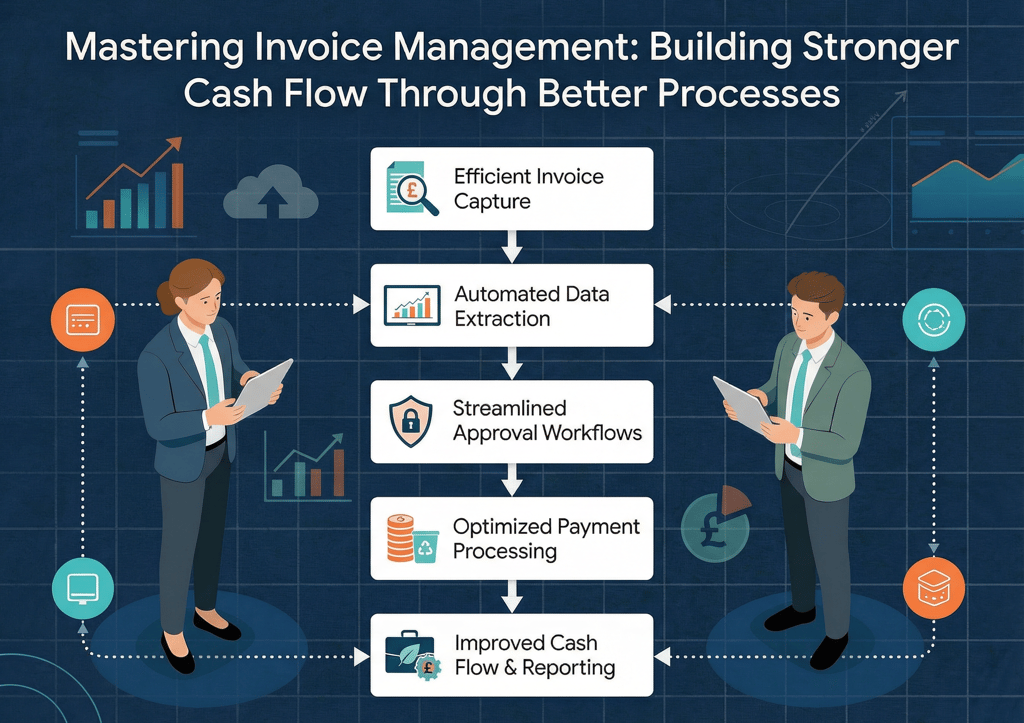
Mastering Invoice Management: Building Stronger Cash Flow Through Better Processes
9/4/20254 min read
The start of a new year often brings a renewed focus on efficiency, control and financial resilience. For finance, accounts payable and procurement teams, few areas offer as much immediate impact as invoice management.
Invoice management sits at the centre of cash flow control, supplier relationships and financial compliance. When it works well, payments are predictable, suppliers are paid on time and finance teams have clear visibility over obligations. When it breaks down, the effects ripple quickly across the business.
What Is Invoice Management?
Invoice management is the end-to-end process of receiving, validating, approving, paying and archiving supplier invoices. Its purpose is to ensure invoices are accurate, compliant with internal and external requirements, and settled on time.
A well-designed invoice management process enables:
clear visibility over incoming and outgoing payments
accurate expense tracking
predictable cash flow planning
stable supplier relationships
It is a foundational process for operational and financial stability.
Why Invoice Management Is Often Challenging
Despite its importance, invoice management is rarely straightforward. Many organisations still rely heavily on manual handling, fragmented systems and informal workflows.
Common issues include:
delays caused by manual routing and approvals
data entry errors and mismatches
lost or duplicated invoices
limited real-time visibility
These problems do not just slow payments. They increase compliance risk, strain supplier relationships and make forecasting more difficult.
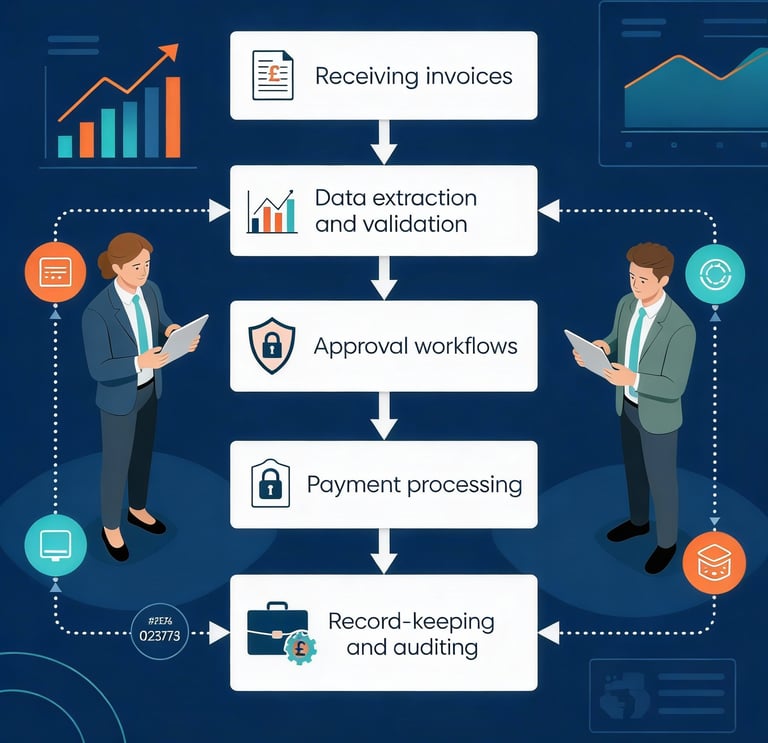
The Core Stages of the Invoice Management Process
Effective invoice management follows a structured sequence of steps. Weakness at any stage can undermine the entire process.
1. Receiving Invoices
Invoices may arrive via email, post or electronic data exchange. Each method presents its own risks:
emailed invoices can be overlooked without a central inbox
paper invoices can be delayed or misplaced
electronic formats may contain incomplete or incompatible data
Missing or incorrect information at this stage is a frequent cause of downstream delays.
2. Data Extraction and Validation
Key invoice data must be captured accurately, including:
supplier details and bank information
purchase order references
amounts, taxes and line items
Errors here lead directly to payment issues. Automated extraction and validation tools can significantly reduce manual input and flag discrepancies early.
3. Approval Workflows
Clear approval structures are essential to avoid bottlenecks. Effective workflows:
define who approves what and when
route invoices based on value or department
maintain an audit trail
Poorly defined responsibilities are one of the most common causes of late payments.
4. Payment Processing
Once approved, invoices must be paid in line with agreed terms. Strong payment processes support:
accurate scheduling
optimisation of payment timing
capture of early payment discounts where appropriate
Automation at this stage reduces errors and ensures consistency.
5. Record-Keeping and Audit Readiness
Invoices must be retained for tax, audit and regulatory purposes. Digital archiving enables:
quick retrieval of documents
consistent record retention
simplified audit preparation
Good record-keeping is not just about compliance — it also supports internal control and transparency.
Common Invoice Management Challenges
Even mature organisations encounter recurring obstacles.
Manual Processing Errors
Manual data entry increases the risk of incorrect amounts, duplicate payments and misallocated costs.
Approval Delays
Invoices often stall in inboxes due to unclear ownership or lack of visibility, leading to late payments and supplier dissatisfaction.
Fraud and Control Risks
Invoice fraud, phishing and payment diversion remain significant risks. Robust validation, segregation of duties and staff awareness are critical.
Limited Visibility and Reporting
Without centralised data, finance teams struggle to see total exposure, upcoming payments or process inefficiencies.
Best Practices for Modern Invoice Management
Organisations that modernise invoice management typically focus on a combination of process design, technology and governance.
Automating Accounts Payable Processes
Automation reduces manual effort, shortens cycle times and improves accuracy by:
matching invoices to purchase orders automatically
routing approvals based on predefined rules
reducing reliance on email and spreadsheets
Moving to Electronic Invoicing
Electronic invoicing improves speed, reduces paper handling and supports regulatory compliance, particularly in cross-border environments.
Strengthening Approval and Control Frameworks
Clear policies, defined thresholds and consistent workflows reduce delays and improve accountability.
Ensuring Compliance and Security
Invoice processes must support tax compliance, data protection and internal controls through:
secure access controls
encryption of financial data
regular reviews and audits
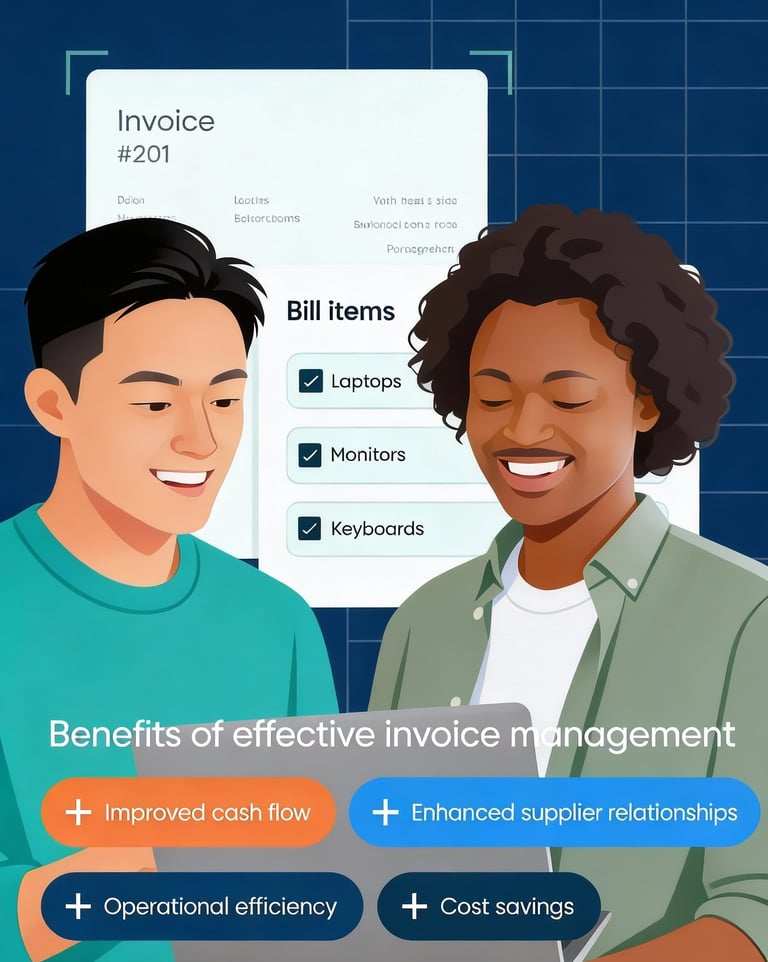
The Benefits of Effective Invoice Management
When invoice management is well structured, the benefits extend well beyond the finance function.
Improved Cash Flow Control
Better visibility enables more accurate forecasting and planning, reducing unexpected cash pressure.
Stronger Supplier Relationships
Timely, accurate payments build trust and may lead to better commercial terms.
Greater Operational Efficiency
Automation frees finance teams from repetitive tasks, allowing more focus on analysis and decision support.
Cost Savings
Reduced processing costs, fewer errors and avoidance of penalties all contribute to measurable savings.
Emerging Trends Shaping Invoice Management
Invoice management continues to evolve as technology and expectations change.
Artificial Intelligence and Analytics
AI is increasingly used to:
detect anomalies and potential fraud
identify process inefficiencies
provide predictive insights into payment behaviour
Sustainability and Paperless Processes
Digital invoicing supports environmental goals by reducing paper use and improving transparency.
Enhanced Transparency and Traceability
New technologies are improving audit trails and trust between buyers and suppliers, particularly in complex supply chains.
Conclusion
Invoice management is no longer a purely administrative task. It is a strategic process that influences cash flow, compliance, supplier relationships and operational efficiency.
By strengthening processes, improving visibility and adopting modern best practices, organisations can move from reactive invoice handling to controlled, predictable financial operations.
Mastering invoice management is not about processing invoices faster — it is about building a resilient financial foundation that supports long-term business stability and growth.